|
Common Name: Royal Paulownia, Empress Tree, Princess Tree, Kiri Tree, Sapphire Princess, Kawakami, Foxglove Tree Scientific Name: Paulownia tomentosa (the species name tomentosa means covered with small hairs and refers to the hirsute appearance of the young leaves; also identified as P. imperialis as a reflection of the imperial lineage associated with the name)
The common name Royal Paulownia is taken directly from the genus Paulownia which was coined by a Dutch botanist named Siebold to honor Anna Pavlovna, the Queen of the Netherlands from 1840 to 1865. Anna Pavlovna was the daughter of Tsar Pavil I of Russia, the son of and successor to Catherine the Great. She was betrothed to the Dutch crown prince William by her brother Tsar Alexander I. The prince became King William II of the Netherlands in 1840 and Anna was the Queen until her death in 1865. Paul is the anglicized form of Pavil and the cognomen Pavlovna reflects the Russian custom of naming the daughter for the father with the suffix "ovna" to indicate the relationship. Empress tree and Princess tree also reflect the royal association.
Royal Paulownia is an introduced ornamental that has spread beyond its original isolated plantations to become pervasive, but not invasive. This is because it is a pioneer species, one that needs only bare soil, adequate moisture and direct sunlight for germination. Unlike other introduced species, it produces only scattered groupings on disturbed sites and does not displace native populations to any great extent. This makes it ideal for reclamation of areas used for strip-mining and along road cuts.
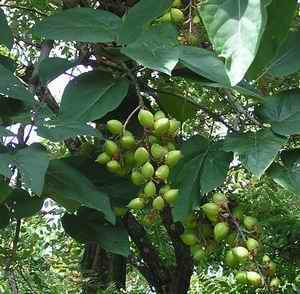
The spread of P. tomentosa is attributed to its prodigious number of seeds, as many as 20 million seeds per year for a single large tree. The seeds are contained in ovoid, pointed, woody capsule-like fruit that each contains about 2,000 seeds. During the early 19th Century, the fluffy seeds were used as packing material for crates shipped from China. The seeds spread from the ports of entry where the crates and packing were discarded. A study in 1993 concluded that the prevalence of 20 year old trees in Virginia coincided with Hurricane Camille in 1969, which brought the seeds from the Gulf Coast.
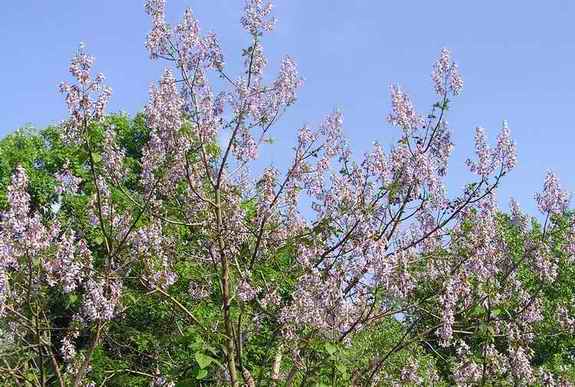
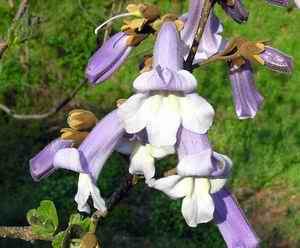
P. tomentosa is native to China, where it is the subject of several ancient legends. It was a custom to plant a "Kiri Tree" when a daughter was born. As the daughter grew to womanhood, the tree grew to full efflorescence. As the local matchmaker made the rounds of the local farmhouses seeking young women for marriage, she was drawn to the farmhouse that was graced by this beautiful tree, its large lavender trumpet flowers signaling the presence of fecundity. The Empress Tree was also associated in Chinese legend with the mythical Phoenix, the bird that is a symbol of immortality in setting itself on fire as a means of rejuvenation. It was said that the bird would only alight when a benign ruler was in power in the noblest tree in the vicinity. It thus became the custom for every major habitation to have a tree.
The wood of P. tomentosa has unique properties that have made it a valuable timber tree in Asia; first reports of its use date back to 300 BCE. It is soft and brittle when freshly cut so that it can be readily fashioned with hand tools. As it ages, it becomes hard and strong. It is light in weight, like balsa wood, and absorbs moisture. It was anthropomorphized in China as "chuh-tzu," a man of complete virtue, as the tree has a tender heart and strong character. The resonant quality of the wood made it ideal for the manufacture of the sonorous fish-shaped hollow bells that are used in Buddhist monasteries to summon the monks to prayer. Paulownia leaves were used to make cleansing agents that were applied to prevent wrinkles and gray hair.
The Empress tree was introduced into Japan from China, where it was in such high demand that it was eventually harvested to extinction. The wood of the tree has a pale color, a superior luster and delicate grain that appeal to the Japanese esthetic. Tansu, the traditional chest of drawers made for the bride's trousseau, has been made out of Paulownia since the Edo era (1603-1867, Edo was the former name of Tokyo). The properties of the wood protect the delicate silk kimonos from mildew during the months of high humidity by absorbing the moisture. During the dry months, the wood contracts to allow air to pass through the chest to air out the kimonos. Other cabinets, such as the Nagamochi, or Japanese long chest, took advantage of the refractory properties of the wood to provide a fire-protected storage cabinet for important documents. The extent to which the Paulownia is an integral part of Japanese culture is best exemplified by the fact that it is the engraving featured on the 500 Yen coin. |